
What to include in payment terms
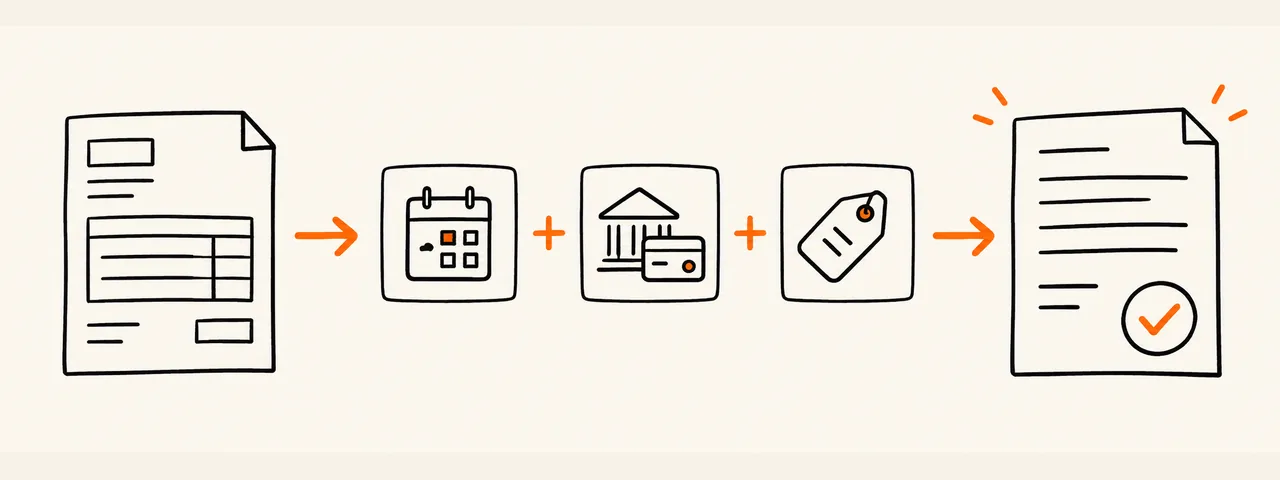
Keep the practical instructions in one place: the exact due date, the accepted payment method and the invoice number or other payment reference. Add an agreed deposit or milestone schedule when it applies.
Payment is due by October 15, 2026. Please pay by bank transfer and use INV-0042 as the payment reference.
- A specific payment due date
- The accepted payment method and necessary payment details
- The invoice number to use as a reference
- Any agreed deposit or milestone schedule
Build payment terms with an actual due date
Choose the invoice date and payment window. The builder counts calendar days and writes a sentence you can copy. Change the method and reference so they match the way you expect the client to pay.
The calculator counts calendar days. Check the agreement yourself if it uses business days, starts on receipt or treats holidays differently.
Payment due on a specific date
A written date removes a calculation from the client’s side. Replace every bracket, then check that the same date appears in the invoice Due date field.
Payment due by [date]. Please use invoice [number] as the payment reference. Payment method: [method]. Payment details: [details].
Net 7, Net 15, Net 30, Net 45 and Net 60
These labels describe payment windows of 7, 15, 30, 45 or 60 days. The calculator on this page counts calendar days from the invoice date. If your agreement starts on receipt, uses business days or treats holidays differently, calculate the date under that rule instead. Put the actual due date beside the shorthand so the client does not need to calculate it.
Net 7 — Payment is due by September 12, 2026.
Net 15 — Payment is due by September 20, 2026.
Net 30 — Payment is due by October 5, 2026.
Net 45 — Payment is due by October 20, 2026.
Net 60 — Payment is due by November 4, 2026.

Dates above use an invoice date of September 5, 2026 and calendar days.
- Confirm when the agreed payment window starts.
- Do not choose a payment window only because a template uses it.
- For receipt-based timing, confirm the billing recipient and delivery method.
Deposit and final payment terms
State the amount and timing of each payment. If the deposit has already been collected, make that clear and check that the amount requested matches the remaining balance.
A [percentage]% deposit of [amount] is due by [date] before work begins. The remaining balance of [amount] is due by [date] after [milestone]. Payment method: [method].
Can you add late fees to invoice terms?
Do not add interest, penalties or collection charges only because they appear in a template. Their use depends on the agreement and the rules that apply to the transaction. Confirm the fee, trigger, calculation and required notice separately; this page does not decide whether a fee is allowed or enforceable.
Optional structure — use only after checking your agreement and applicable rules:
Payment is due on [date]. If the amount remains unpaid after [trigger date], the agreed late charge of [exact amount or calculation] may apply. Contact [billing contact] if the invoice is disputed.
- Check that the client agreed to the term before the invoice became overdue.
- State the exact trigger date rather than only saying “late”.
- Explain whether the charge is a fixed amount or a calculation, without leaving competing formulas.
- Keep collection threats or legal claims out of a routine template unless they are accurate and appropriate.
Check the instructions before sending
Read the payment terms alongside the invoice total and due-date field.
- The dates agree across the document.
- The payment details are correct and complete.
- The invoice reference matches the document number.
- The amount requested reflects any deposit already paid.
- All brackets and sample wording have been replaced.